
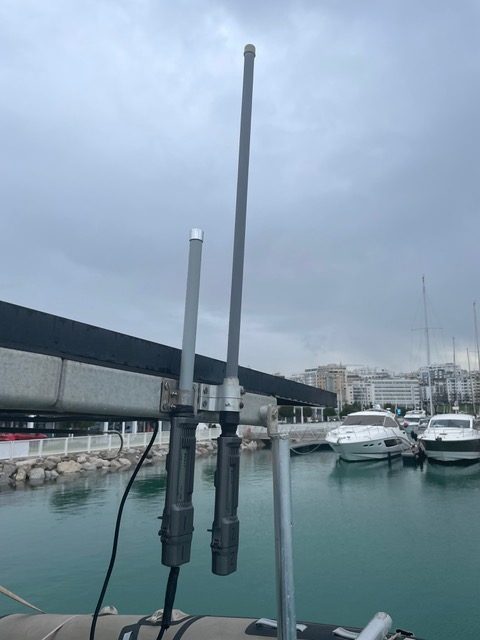
Up until very recently, our Internet on the boat has largely come from wifi signals (often a marina wifi network) grabbed by either our Ubiquiti Bullet (circa 2010) or MikroTik Groove (circa 2017). A few posts ago, I lamented over the extremely poor marina wifi here in Tangiers. Not only has the network administrator found a way to bump wifi amplifiers (like mine) off the network, but they decided that they would limit wifi connections (leases) to only 30 minutes! Supposedly “like in the airport”. This is very bad. Both my former Groove and Bullet were due for a technology upgrade, so I replaced them with two new MikroTik Metal 52ac – which is essentially the newest version of the Groove.

As a point of interest, I have read that the number of different configurations possible with a MikroTik Groove, which runs the full-featured RouterOS software, is virtually unlimited. The device is a fully programmable router that can be configured for a vast array of networking tasks, and is not a device with a fixed number of settings.
These possibilities stem from:
Diverse Functionality: RouterOS supports an extensive range of network functions, including complex firewall rules, routing protocols (MPLS, BGP, etc.), VPNs (IPsec, OpenVPN, WireGuard), DHCP, QoS, VLANs, and more.
Programmability: The device can be configured using a powerful command-line interface (CLI), a graphical utility called WinBox (which I used extensively), a web interface (WebFig), or an API for custom applications, allowing for intricate and highly specific setups.
Combinatorial Complexity: The number of combinations of settings, rules, and parameters across all the available features is immense. For example, a user can create countless different firewall rules, assign an almost infinite number of possible IP addresses, configure numerous virtual interfaces, and combine these features in countless ways.
Flexible Deployment Modes: The Groove can be configured in various default modes like a CPE (Client Premises Equipment) router, an AP (Access Point) router, a point-to-point bridge, or a WISP (Wireless Internet Service Provider) bridge, each serving as a starting point for further customization. The basic configuration that I had success with was as a CPE + router. I also tried bridge and pseudo-bridge, but was unsuccessful.
In essence, while the physical hardware has limits (one Ethernet port, one wireless interface), the software configuration options provided by RouterOS are so extensive and flexible that there is no practical limit to the number of unique configurations a user can create.
With this in mind, it should come as no surprise that most (yes, most) cruisers feel that programming and operating one of these things may well be beyond their skillset. In truth, the first two devices that I had delivered (in 2010 and 2017) arrived pre-configured for the purpose I had in mind (to fetch remote wifi signals and push the Internet data to my onboard network router). However, it is getting more difficult to find people that are trained and experienced to do these configurations. Therefore, I went out on a limb and bought two new ones (made in Latvia and sold on Amazon) a few weeks ago and set out to configure them myself. Given the lack of accurate reference material, I’m not ashamed to admit that I had the assistance of AI tools, namely: ChatGPT, Grok and Deepseek. I found the Chinese developed Deepseek to be the most effective tool, as it had the best understanding of the windows, tabs and firmware features necessary to set the device up. I would not be exaggerating if I said it took me approximately 60 hours of time for the first one, and yet only 2 hours for the second one. The user interface is the most complicated one I have ever seen. However, now that they are both configured (same job, just one is a spare), it is a fairly simple matter to change the Internet source (10 minutes). These two new Grooves are now on the stern, with one configured to catch Internet from our Moroccan Orange mifi (mobile wifi) device.
So, my STARLINK mini install is also finished. This device is both a satellite transceiver and wifi router built into one. As you can see from this photo, I’ve mounted it on the stern, port side of the solar panels.

For the power supply, I tapped into an available 12V circuit and connected through a switch, 10A fuse and 12V-48V converter. The provided wire is very thin, and although some say that it will run on 12V, that’s not quite true. It depends on the cable length and voltage at source. The 220V converter provided with the equipment puts out a 30VDC signal. On the Internet, I have read that some people used a 12V-24V converter to bump up the voltage, but with any higher voltage, the current will be lower — so I erred on the low current side with a 48V converter, as used by some.


The STARLINK mini is right next to both Grooves, so there should be no problem getting a connection on either 2.4 or 5GHz, when I do that. At the moment, both networks are available inside the boat (below the steel deck), although the 2.4GHz network has a stronger signal. As measure, the STARLINK mini actual current draw, is only about 2A @ 13.2V. This is what my network looks like, with the STARLINK, mifi, Groove(s) and “inside the boat wifi network”.

Some people are bound to ask: “since the STARLINK mini already has a built-in router, broadcasting from the dish, why bother with another inside the boat network”? The rationale for this is that we have a metal boat with a metal deck, which can, and does produce obstacles to wifi distribution. After installation, I did test the mini, which produces both a 2.4GHz and a 5GHz network, and the lower frequency seems to promulgate throughout most of the boat. However, I’m concerned with best propagation, and we have a lot of devices: two MacBook Airs, two iPads, two iPhones, two Kindles, a navigation/desktop computer, a network printer, a WYZE network camera and finally several SMART plugs. With a separate boat network, we have redundancy and the best propagation to all devices, in all areas of the boat.
I am very pleased with the installation, but we’re not using it yet, not just yet. Although the download speed is very solid at 100Mbps plus, noticeably higher than our 4G cellular mifi device at only 5-10 Mbps, our mifi device actually barely meets our needs and is cheaper at only 30 euros per month (no data limit). The best roam plan for our STARLINK mini is only 78 euros per month (no data limit). However, the problem is that we are currently physically located in Morocco, a country that does not yet have contracted service. Yes, the satellites cover the area, but there is no legal service. Therefore, whatever we have, can be turned off on short notice. Therefore, we are postponing changing our service plan from standby (0.5Mbps) and only 5 euros per month – for a few months, until we set out for Spain again.
We are suffering through the worst winter we have experienced in a long, long time. Since arriving in Turkey in June 2020, we have had five winters: Turkey (3), then Tunisia and Spain. This, our sixth winter in “the Med area” is the worst because of a never ending series of storms that have been bashing the area in January and now the early part of February. It is not just Morocco, or even the Atlantic coast of Spain, but it appears to be most of Europe. We had hail here several times, with a daytime temperature of 14C and night temperatures of 10C.

The last thing I did was to remove a Chinese LiFePO4 60A battery charger (bought in 2019). Over a few weeks, it started to give wonky outputs, and finally it just didn’t work any longer. I did take it apart, and scavenged some parts, but it couldn’t be repaired. I simply replaced it with a different model 60A charger, from AliExpress. For convenience, I mounted it upside down next to the house bank. The display is a little awkward to read, but it’s not something you need to look at anyway.

Weather terrible here too, but I am living in a home with new heat pumps and a new Navien NHB condensing boilers for my old radiators, which still provide a very warm and comfortable heat.
I think it’s a bit of a shock to most people in NA and Europe that the winter has been so cold, yet the Arctic is still warming 4 times faster than here.
When are you guys coming home? How is the family doing?
Wow, another well thought-out, well designed, well configured, well tested, well documented solution. What a Can-Do attitude! We could use some more of that back here at home.